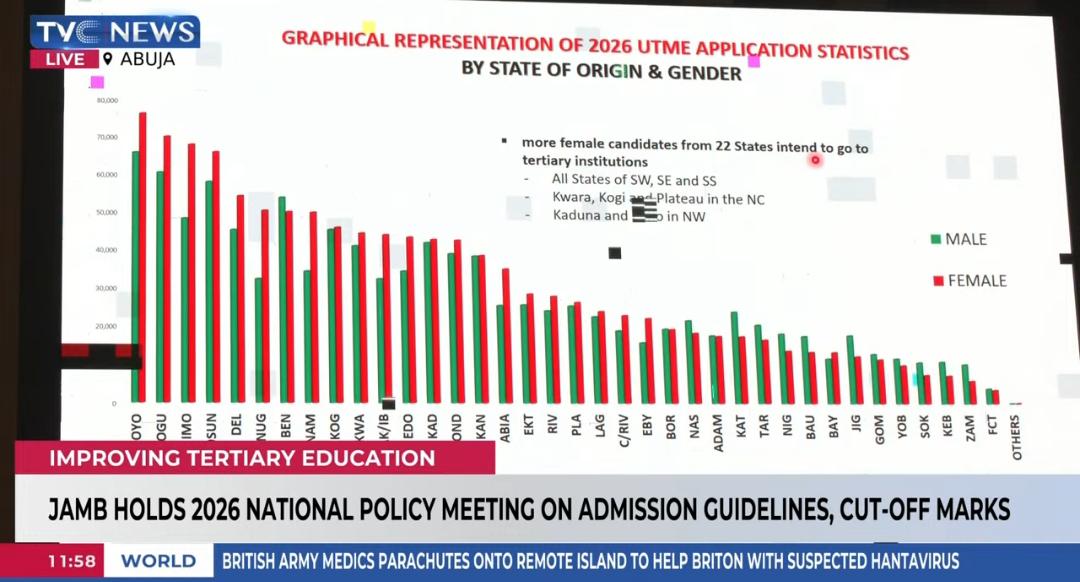
The recently concluded 2026 National Policy Meeting in Abuja has dropped another fascinating statistic: the gender gap in Nigerian higher education is shifting. According to the latest registration data from the Joint Admissions and Matriculation Board (JAMB), female candidates have officially outnumbered males in 22 out of Nigeria's 36 states.
This trend highlights a growing drive for girl-child education across the federation, marking a significant milestone in the country’s academic history.
1. The National Gender Breakdown
For the 2026/2027 academic session, JAMB recorded a total of 2,243,816 registered candidates—the highest number in the Board's history. While the national total shows a near-equal split, the state-by-state data reveals that young women are now more eager than ever to secure tertiary seats.
- Total Registered: 2,243,816
- Female Lead: Females out-registered males in 22 states.
- Overall Trend: This continues a pattern seen in 2024 and 2025, where female enrollment has been steadily climbing toward and, in many regions, surpassing male enrollment.
2. Where are the Females Leading?
The "Female Majority" states are spread across various geopolitical zones, though the trend is most dominant in the South-West, South-East, and South-South regions. In states like Lagos, Ogun, and Enugu, female applicants have consistently held the majority for the last few cycles.
Even in some North-Central states, the numbers are tilting. This shift is attributed to increased advocacy for female education and the rising economic necessity for double-income households, driving more young women into professional career paths.
3. What Does This Mean for the 2026 Admissions?
With more females sitting for the exam, we are likely to see:
- Higher Competition in Certain Courses: Historically, female candidates have a strong presence in the Social Sciences, Education, Nursing, and Humanities. These faculties will likely see even tighter cut-off marks this year.
- A Shift in Workforce Talent: As these women graduate, the Nigerian labor market—particularly in sectors like Healthcare and Education—will see a significant influx of female professionals.
- The "Education Scrapping" Effect: Since Education and Agriculture candidates are now exempted from the UTME for the 2026/2027 session, many of these female applicants (who dominate the Education faculty) will move directly to the screening stage based on their O'Level results.
4. Summary of the 2026 Registration Statistics
| Category | Data |
| --- | --- |
| Total Registered Candidates | 2,243,816 |
| States with Female Majority | 22 States |
| Top Registration State | Lagos (321,814 candidates) |
| Lowest Registration State | Zamfara (14,841 candidates) |
| International Entries | Candidates from 10 Foreign Countries |
The Bottom Line
The 2026 UTME data isn't just about scores; it’s a social indicator. The fact that more females are applying for tertiary education in 22 states proves that the barriers to girl-child education are crumbling. Whether it's the 16-year age rule or the new exemption for Education students, young Nigerian women are positioning themselves at the forefront of the country's academic future.